


What is ETL? The complete ETL process explained
ETL is the plumbing of every dashboard. Nobody sees it until the figures are wrong or late.
ETL in short
- ETL stands for extract, transform and load: you extract data from source systems, transform it into a structure suitable for analysis and load it into a database such as a data warehouse.
- With ETL you fill a data warehouse, or migrate or copy data from one system to another. ETL tools automate the process, so that you do not have to script it by hand.
- The best moment to check data quality is between extraction and transformation.
- A nightly ETL run should take two hours at most. If it takes longer, consider real-time ETL.
- Metadata management makes impact analysis and data lineage possible: where is a field used, and how is a KPI built up?
What is ETL and what does the abbreviation stand for?
Extracting data from all kinds of systems, then transforming it and loading it into a new database or environment is called ETL for short: extract, transform and load. The advantage of a structured ETL process is that you can bring data from different systems together, clean it, link it and pour it into a structure that is very suitable for analyzing or viewing data quickly. After all, you want data at hand always and everywhere, and above all you want no duplicates.
- Extract: you select and filter data from your sources and transfer it to a temporary storage place, in memory or on disk. An example is selecting the orders and order lines that came in yesterday. During extraction you often apply change data capture, so that you only select data that has been added since the previous load.
- Transform: you transform the data into a structure that is better suited to analyzing large amounts of data. For example, you go from a strongly normalized structure to a denormalized one, such as a dimensional model with a star schema or snowflake schema.
- Load: you store the transformed data permanently in a database or file. That can be a data warehouse, a CRM system in which you want to see customer data from other systems, or a file with which an analyst or controller carries out an analysis.
ETL can take place in the cloud (cloud ETL) or on a server in your own data center. With ETL as a service you make data integration available on demand and pay only for use, for example depending on the volume of data, the number of users or the duration of the process. And the relationship with BI? With business intelligence you want to monitor and analyze data quickly through reports, dashboards or algorithms, and for that you need a solid data infrastructure, which you build with ETL.
ETL versus ELT
In modern cloud platforms the order is often reversed: first load, then transform.
ETL
ELT
Order
Extract, transform, load
Extract, load, transform
Where it transforms
On a separate ETL server
In the target database itself
Raw data
Usually not kept
Stays available
Fits
On-premises data warehouses
Cloud data platforms
The complete ETL process
Every ETL process consists of three large steps, but often you need not one process but several. To update a data warehouse every night you may need as many as two hundred ETL processes, each responsible for a piece of the total transformation. If the total process takes too long, it is not finished in the morning and the figures on your dashboard are not updated. So make sure your ETL runs fast and finishes on time. Two hours at most is an acceptable limit. If it takes longer, we advise switching to real-time ETL.
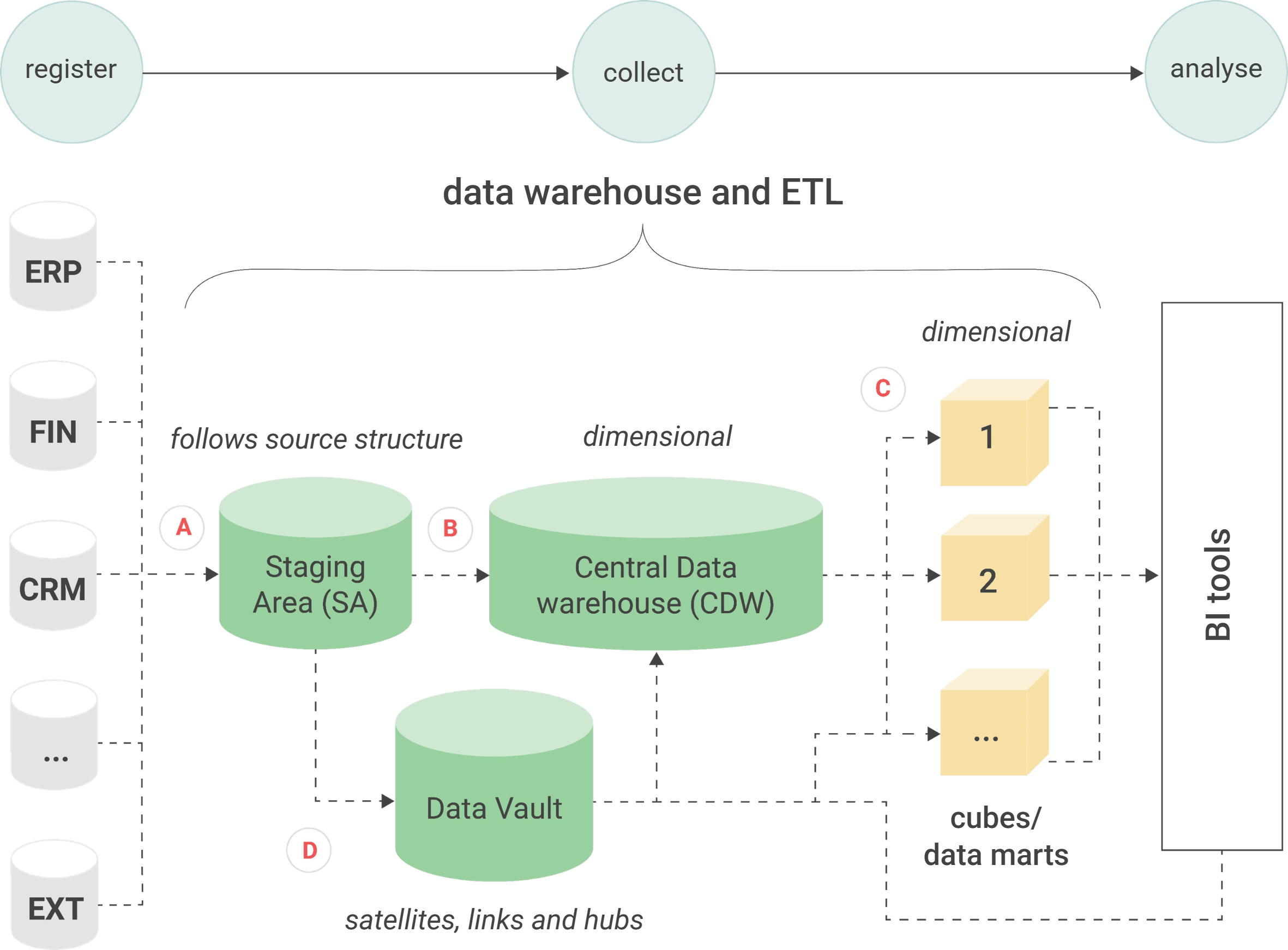
In addition to the three steps you can carry out checks on data quality. The best moment for that is between extraction and transformation.
ETL management: data governance from A to Z
A data manager or ETL manager steers all ETL in an organization in the right direction. We define ETL management as the responsibility for drawing up data definitions and transformations and managing them. The manager is helped by the ETL developer, the data architect, the database administrator, the metadata manager and the data custodian. Together they make sure the ETL processes are well documented and can therefore be maintained well.
What does an ETL developer do?
An ETL developer or specialist develops programs to let the total ETL process run automatically. Often ETL tools are used for this, and nowadays increasingly data warehouse automation tools.
What is ETL compliance?
Especially when you use ETL to fill a data warehouse that feeds dashboards and reports, you must be able to demonstrate that there are no errors in the total ETL process. An auditor or accountant must be able to assume that the figures are complete and built up correctly. So you need ETL compliance to show your accountant that you generate management information correctly.
What is ETL metadata management?
Metadata describes the data in your ETL database. You have to record and manage it well, including the definitions of (calculated) fields. With an impact analysis you can easily find out where which fields are used in the ETL process. With data lineage you can find out how the calculation of a KPI on your dashboard, such as profitability or net margin, is built up and which fields are used for it.
Other topics that play an important role in ETL are connectivity to your source systems, data mappings, data pipelines, scheduling of ETL tasks, data replication and master data management, and the question of whether open-source ETL is an alternative to commercial ETL software.
Big data and ETL
Big data and ETL have had to get used to each other. The ETL tools of ten years ago were not, or only very poorly, able to process unstructured data such as videos, sound clips or sensor data. Nowadays almost all ETL tools can process big data and store it in a data lake. ETL can also use a data lake as a source, for example to fill a table with the number of messages a company posts per day. Combining structured data from a data warehouse with unstructured data from a data lake, in real time or otherwise, remains a great challenge. Big here does not only mean large amounts of data, but also complex data such as videos, documents and sound clips.
Do not turn your ETL into spaghetti
ETL is a complex matter, and before you know it you are saddled with an enormous bowl of spaghetti: ETL code that you can hardly untangle, let alone manage. A future-proof data infrastructure requires standards, documentation and, increasingly, automation.
How Diamond Decisions approaches ETL
We do not write ETL by hand where it can be generated. In our data platform, extraction, history and star schemas are largely automated, which prevents spaghetti and keeps the process explainable to an accountant. What we do not automate is the question of what has to be loaded: that follows from the decisions and KPIs established in business modeling.
Talk to the author
 Rick van der Linden
Diamond Decisions
Discuss your question with Rick
Tell us which decision needs to improve. In a no-obligation conversation we show you where your data delivers the most.
Schedule an introduction →Step 3 of our approach
Diamond Data Analytics
A data warehouse that starts with your most important decisions and is ready for conversational AI: a working prototype within 24 hours.
Explore Data Analytics →Frequently asked questions
01
What does ETL stand for?
ETL stands for extract, transform and load: extracting data from source systems, transforming it into a structure suitable for analysis and loading it into a target database such as a data warehouse.
02
What is the difference between ETL and ELT?
With ETL the data is transformed before it is loaded, on a separate server. With ELT the raw data is loaded first and transformed in the target database itself, which fits cloud data platforms with a lot of computing power and keeps the raw data available.
03
What is change data capture?
A technique in the extraction step that selects only the data that has been added or changed since the previous load. That makes the process faster and reduces the load on the source systems.
04
What is data lineage?
Data lineage shows how a figure, for example a KPI on a dashboard, is built up: from which sources and fields it comes and which transformations it has undergone. It requires good metadata management.
05
How long may an ETL process take?
A nightly run should be finished within about two hours, so that the figures are updated in the morning. If it takes longer, real-time or incremental processing is the better choice.
06
Does a small or mid-sized company need an ETL tool?
As soon as you combine data from two or more systems on a recurring basis, yes. Doing that by hand in spreadsheets costs time every period and leads to errors. A platform that automates the standard ETL work is usually cheaper for a mid-sized company than custom scripts that only one person understands.
Further reading
- Data warehouse: what ETL fills, and the 15 principles.
- Data quality: the checks between extraction and transformation.
- BI architecture: the place of ETL in the whole.
- Management information: what it is all for.
About the author
About Diamond Decisions
Diamond Decisions helps organizations become better by enabling better decisions. We don’t start with data, dashboards or AI, but with the decision that needs to improve, and work back from there to KPIs, data and technology. We do that in four steps: inspiration and alignment, business modeling, analytics and data platform and data-driven decision makers. That way BI and AI don’t remain an IT project, but deliver value every day.