


Key takeaways
- A peep box is a dashboard or report, or a collection of them, that works as a rear-view mirror with which you mainly account for the past.
- A decision box models business intelligence around the concrete decisions a user has to take: operational, tactical or strategic.
- BI maturity has four levels: understanding, coordinating, improving and innovating. Most organisations get stuck at level 1, the report factory.
- The working method is reversed: from decision and action to insight, information and data, instead of from data upwards.
- Modelling the ten most important decisions provides enough data coverage for a clean data architecture.
From still water to a swirling river
Data-driven working is the order of the day. Every organisation wants it or has anchored it in the strategy. But then many organisations build a short-sighted peep box that almost only facilitates looking back. They make great dashboards and put together a data warehouse by the book, yet keep struggling. Data-driven working presupposes that the actions of everyone in the organisation are guided by data and the insights that follow from it. With a peep box that is hardly possible. You look at still water that also clouds over time, and your canoe just bobs around. Decisions are taken on the basis of knowledge, experience, opinions and gut feeling.
To succeed you need to know how to build a decision box. Only then do you get a good view of the swirling river that reflects the operations of your organisation, and can you navigate and anticipate the stream of changes. That is an art, and it requires courage from management.
The short-sighted peep box and accountability
A peep box is a dashboard or a report (or a collection of them) that functions as a rear-view mirror with which you mainly render account.
Peep boxes have no relation to the steering of the organisation and to how you can achieve a better performance together. Looking back yields little apart from information for accountability, which in many sectors sets the tone, fuelled by laws and regulations. If you look in the rear-view mirror too much, you do not see what is happening now and what is coming at you.
Away with the worn-out KPIs
A peep box would not be a big problem if it contained genuine KPIs, and not the worn-out ones everyone talks about, such as customer satisfaction, production, revenue and absenteeism. But peep boxes are often filled to the brim with meaningless, far too general information: an expensive report factory. Mainly the output is monitored; what precedes it has not been modelled and remains invisible, while that is exactly what is crucial. Genuine KPIs sit at the heart of your primary process and are by definition not financial. A peep box focused on them could at least serve as an alarm centre.
Four maturity levels
At Diamond Decisions we see data-driven working, data science and business intelligence as terms you can use interchangeably. Peep boxes are mainly made at maturity level 1: gaining an understanding of the organisation.

- Understanding. At the bottom of the pyramid it is extremely busy: no shortage of peep boxes with dashboards, data warehouses and report factories. This level is mainly used for strategic purposes and monthly steering on the main lines.
- Coordinating. You deliberately use BI to align decisions across teams, departments and domains. The marketing manager doubles the advertising budget for an article; production raises capacity at the start of the campaign. These are tactical, weekly decisions.
- Improving. Organisations deliberately use data to take better decisions and optimise processes daily. This is where the decision box takes shape and where continuous improvement of operations happens.
- Innovating. At the top it is remarkably quiet. Only a handful of organisations innovate with data, such as Netflix or Pon, one of the winners of the Dutch BI & Data Science Award.
It seems odd that the lowest level is used for strategy while it lies closest to the primary processes. That is one of the reasons many organisations get stuck there: it feels like you are doing well because you make things transparent, but with a report factory you do not get to the essence. See also the strong correlation between BI maturity and better performance.
- You cannot jump from the cellar onto the roof: skipping levels is not possible.
- At the lowest level you create legacy that can become so large you cannot get rid of it quickly.
- At a higher level you still need elements of the levels below. Even with AI you keep needing reports, although one algorithm can replace 100 reports.
Peep box versus decision box
The key question is how to escape the lowest level.
Peep box
Decision box
At the centre
The report or dashboard
The concrete decision
Direction of view
Backwards
Now and ahead
Purpose
Rendering account
Deciding better every day
Rhythm
Monthly
Daily and weekly
Working method
From data upwards
From the decision back to data
What is in a decision box?
In a decision box you model business intelligence around the decisions a user has to take. A handy scheme for this is the decision framework.

Implementing the decision box
You build the decision box to take better decisions daily and weekly. Start with decisions that are, or should be, taken in the primary process. Then name the knowledge, the data sources and the information needed. Actions follow from a decision, and afterwards you measure its performance with the genuine KPIs in the “performance” block. You reflect and analyse daily, weekly and monthly until you come across new knowledge. Validate that knowledge by manual data analysis or AI, and when it holds long enough, include it in the decision framework and make it available as data where possible. That is how you turn the PDCA cycle successfully, instead of circling around the report as in a report factory.
For the BI team: from decision to insight to data sources
Most BI teams at the lowest maturity level consist almost entirely of report builders, data engineers and dashboard developers, often with a strong “you ask, we deliver” mentality. That explains why the data is central and reports and dashboards are the goal. Much more knowledge of the business, the processes and the outside world is needed. Filling in the decision frameworks is a joint effort of the BI team and the decision-makers. After that it is relatively easy for the BI team to define which data sources are needed, which information gives fine-grained insight into the situation in relation to the decision, how the KPIs for “performance” are calculated and which analyses are wanted for “reflection and analysis”. The result is an information product: a collection of reports, KPI dashboards and pre-cooked data analyses.
A top-down approach: begin with the end in mind
For an average BI team this takes some getting used to, because the standard working method is turned upside down: no longer from data to information to knowledge and action, but from decision and action to insight, information and data. Building reports or dashboards comes later. The B in BI stands for business, and with a decision box you put it first. Experience shows that you have to train and coach the BI team in the new working method.
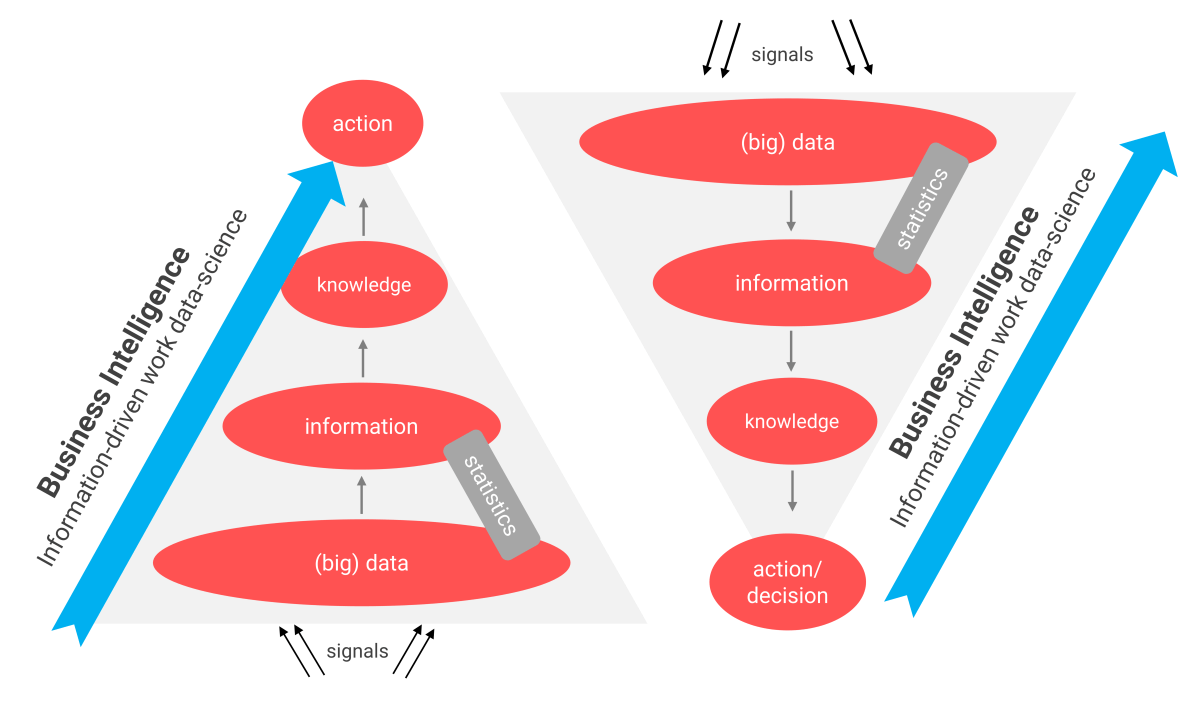
The data architect and the data engineer may object that this way they cannot build a good data architecture. They have a point: if you work out only one decision framework at a time, you end up with an inextricable tangle of data. The remedy: bundle the ten most important decisions of the organisation, model them carefully and make a decision framework for each. On the basis of the blocks “data”, “information”, “performance” and “reflection and analysis” the architect can then arrive at a balanced data architecture. Practice shows that ten decisions give enough data coverage for a clean architecture.
For the decision-makers: the data-driven PDCA
The decision-makers also have to get used to it. They have to unlearn looking in the peep box once in a while and start taking daily and weekly decisions on the basis of data: saying goodbye to gut feeling.
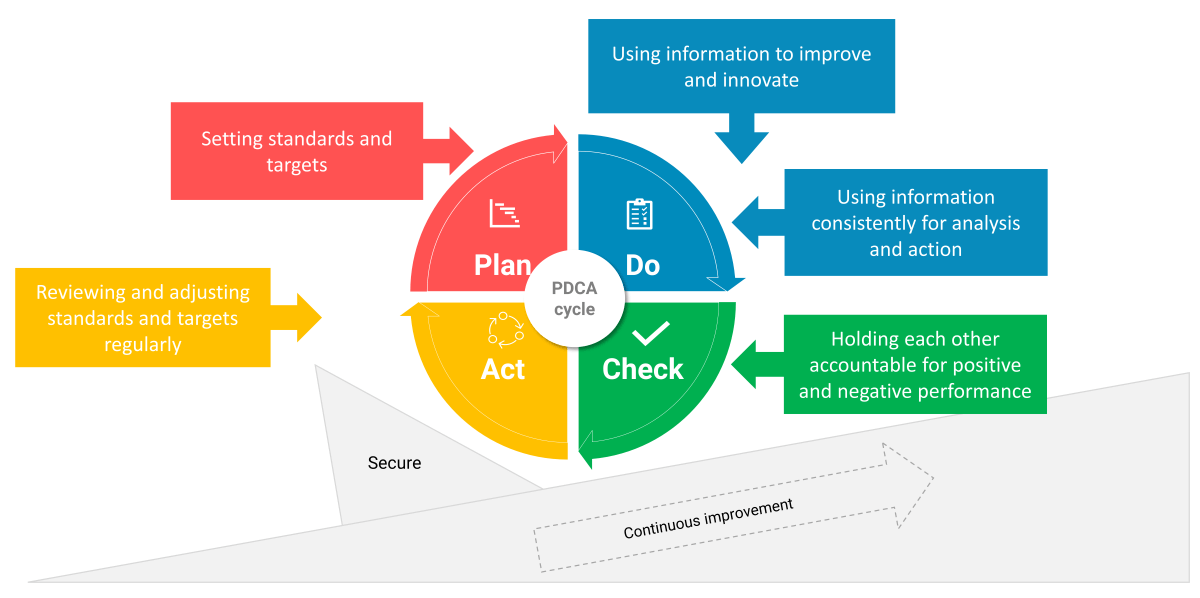
- Evaluate norms and targets regularly and adjust them. Not once a year, but weekly, monthly or quarterly. Base them on historical data and differentiate: not one target for all products or customer segments. That makes the P and the A of PDCA data-driven.
- Use information consistently for analysis and action. In daily execution you use information for monitoring, analysis and action. When a norm is exceeded you look for the root cause. See also without data analysis BI is pointless.
- Discuss performance with each other daily, weekly and monthly. With good and bad results alike you have the conversation: informally every day, more thoroughly every week and month.
How Diamond Decisions builds the decision box
This is the Diamond Decisions method in a nutshell. In Business Modeling the most important decisions are modelled with the decision-makers. Data analytics then delivers exactly the data and information those decisions need, and in Decision makers teams learn to work with the data-driven PDCA. It starts with an inspiration session in Diamond Inspirations.
7 tips for building a decision box
- Develop a radical vision of BI and data-driven working, so that everyone can explain what it is and what it contributes to the success of the organisation.
- Make the decision frameworks the standard for the further development of your BI and analytics products.
- Move from a few big, coarse decisions per month to a large number of daily micro-decisions. That is how you optimise your processes step by step and make the organisation more agile.
- Organise an inspiration session so that everyone knows what data-driven working entails. A good understanding is the starting point for growth.
- Abandon the idea that norms are static. Setting norms is a dynamic process in which differentiation makes the difference.
- Do it together: let operations, IT, finance, HR and BI act jointly.
- The decision frameworks are a stepping stone to artificial intelligence, because every decision can later be automated with AI. But do not start with AI before you have built a decision box and used it successfully for some time.
If you do not understand your own business and process, learning is difficult. “You only see it when you get it,” Johan Cruijff once said.
Summary and conclusion
Many organisations get stuck at the lowest maturity level because the peep box has become sacred and people stare themselves blind on reports and dashboards. Opening the decision box reveals a new world in which concrete decisions set the tone. With the decision frameworks you can shape both the work of the BI team and that of the decision-makers. That does not happen without a struggle, but it makes it all the more exciting.
Talk to the author
 Daan van Beek
Diamond Decisions
Discuss your question with Daan
From ambition to action. In a no-obligation conversation we explore together which KPIs and indicators really matter.
Schedule an introduction →Step 2 of our approach
Business Modeling
Together we translate your strategy into a business model with clear KPIs and goals.
Explore Business Modeling →Frequently asked questions
01
What is a decision box?
A decision box is a set of BI products built around the concrete decisions people have to take. For each decision it contains the knowledge, information and data needed, the KPIs that measure the result and the analyses for reflection.
02
What is the difference between a peep box and a decision box?
A peep box looks back and serves accountability; the report is central. A decision box looks at now and ahead and serves daily and weekly decisions; the decision is central and the data is derived from it.
03
How many decisions should you model to start with?
Bundle the ten most important decisions of the organisation. In practice that gives enough data coverage to design a clean, balanced data architecture.
04
Is a decision box feasible for a small or medium-sized business?
Yes. You can start with one or a few decisions in the primary process and the data needed for them. That is smaller and cheaper than building a broad data warehouse with many dashboards first.
Further reading
About the author
About Diamond Decisions
Diamond Decisions helps organizations become better by enabling better decisions. We don’t start with data, dashboards or AI, but with the decision that needs to improve, and work back from there to KPIs, data and technology. We do that in four steps: inspiration and alignment, business modeling, analytics and data platform and data-driven decision makers. That way BI and AI don’t remain an IT project, but deliver value every day.